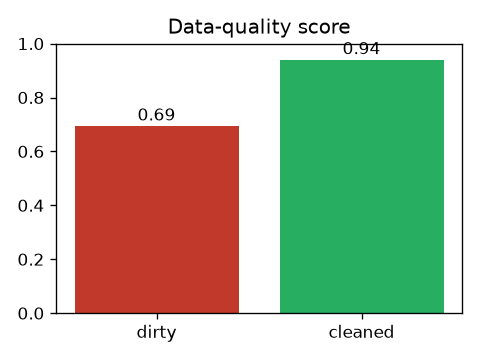
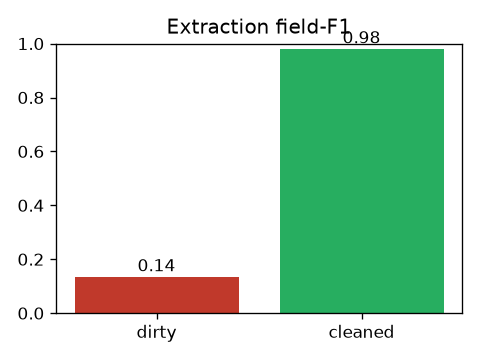
TL;DR: Dirty contract PDFs — mojibake, hyphenation, repeated headers, near-duplicates — quietly wreck RAG. On a committed synthetic set of 8 contracts, cleaning raises the data-quality score from 0.69 to 0.94 (+0.25) and extraction field-F1 from 0.14 to 0.98 (+0.85) — and you can reproduce every number with one command, no API key.
Real enterprise documents arrive with utf-8/latin-1 mojibake, words split across line breaks, page headers repeated on every page, and near-duplicate blocks. Retrieval returns noise; extraction cites the wrong block.
Every parser converges to one Document IR. An ordered, pure clean pipeline fixes unicode, de-hyphenates, strips repeated headers, de-dupes, and normalizes whitespace. An explainable quality score flags what still needs review. Extraction then returns sourced, confidence-scored facts — every value a verbatim span of its cited block.
git clone <repo> && cd contract-rag
uv sync --extra dev --extra benchmark
python -m contract_rag.benchmark
You will get the same field-F1 (0.14 → 0.98) and quality (0.69 → 0.94) numbers shown above.
The dirt here is simulated by a seeded corruption suite on synthetic contracts, so this proves the pipeline's recovery behavior end-to-end — not real-world OCR accuracy. On real labeled contracts (CUAD, download-gated) the same cleaning lifts field-F1 from 0.33 to 0.70.
If your RAG returns garbage on real contracts, we will run this before/after on one of your de-identified documents and show you the numbers. Open an issue or get in touch.